The Third Turning of the Wheel by Reb Anderson
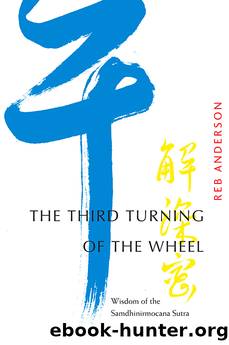
Author:Reb Anderson
Language: eng
Format: epub
Publisher: Shambhala
Meditating on the Other-Dependent
The buddha begins by telling Paramarthasamudgata, “I initially teach doctrines starting with the lack of own-being in terms of production to those beings who have not generated roots of virtue, who have not purified obstructions, who have not ripened their continuums, who do not have much conviction, and who have not completed the accumulations of merit and wisdom. When they hear those doctrines, they understand dependently originated compounded phenomena as being impermanent. They know them to be phenomena that are unstable, unworthy of confidence, and changeable, whereupon they develop aversion and antipathy toward all compounded phenomena.” (107)
Notice that he says when beings have heard this teaching. He doesn’t say when they know it, or when they see the other-dependent character. He says when they hear the teaching about it. So part of honoring the other-dependent character is to hear these teachings. But I don’t think he meant that we just have to hear the teachings once. I think he means that we should hear them pretty often. In fact, you have to hear the teaching until it is in your heart all day long. Every time you look at something, somebody is in your ear saying: “This thing has an other-dependent character. This phenomenon is a lack of own-being in terms of self-production. This thing can’t produce itself. This thing can’t keep itself going another moment.” Until you have a little buddha in your ear telling you that, you have to work to always keep this teaching before you. You need to reremember the teaching until it runs through your mind all the time.
This is the basic meditation, and when you move on to other meditations, this meditation should continue. After a while, it is just like your heartbeat. So one way to honor the teaching is to listen to it, and repeat it over and over again to yourself. Another way to honor it is by reading about it, reciting it, and talking to others about it. You can also honor what the teaching points to; you can honor the way phenomena really are. Of course, other-dependence isn’t the whole story about how phenomena really are, but it is the fundamental character of the way they are. So we start to train ourselves by meditating on this teaching, training ourselves to open our wisdom eye to the actual nature of phenomena, rather than the misconceived or mistaken way that phenomena are seen to be.
One way to get at this meditation is to receive what is given. When something happens, receive it. Understand that what’s happening is given to you. Then meditate on that, and look to see whether or not you are receiving what’s given, or whether you actually think you make what’s happening happen. There is a bodhisattva precept (it’s number two of the ten grave precepts) called “Not taking what is not given.” If you have a body or a thought, and you don’t think it’s given, don’t take it. Give up the mode of taking action.
Download
This site does not store any files on its server. We only index and link to content provided by other sites. Please contact the content providers to delete copyright contents if any and email us, we'll remove relevant links or contents immediately.
| Anthropology | Archaeology |
| Philosophy | Politics & Government |
| Social Sciences | Sociology |
| Women's Studies |
The remains of the day by Kazuo Ishiguro(9006)
Tools of Titans by Timothy Ferriss(8403)
Giovanni's Room by James Baldwin(7354)
The Black Swan by Nassim Nicholas Taleb(7137)
Inner Engineering: A Yogi's Guide to Joy by Sadhguru(6800)
The Way of Zen by Alan W. Watts(6621)
The Power of Now: A Guide to Spiritual Enlightenment by Eckhart Tolle(5790)
Asking the Right Questions: A Guide to Critical Thinking by M. Neil Browne & Stuart M. Keeley(5779)
The Six Wives Of Henry VIII (WOMEN IN HISTORY) by Fraser Antonia(5519)
Astrophysics for People in a Hurry by Neil DeGrasse Tyson(5196)
Housekeeping by Marilynne Robinson(4455)
12 Rules for Life by Jordan B. Peterson(4312)
Ikigai by Héctor García & Francesc Miralles(4279)
Double Down (Diary of a Wimpy Kid Book 11) by Jeff Kinney(4278)
The Ethical Slut by Janet W. Hardy(4262)
Skin in the Game by Nassim Nicholas Taleb(4257)
The Art of Happiness by The Dalai Lama(4133)
Skin in the Game: Hidden Asymmetries in Daily Life by Nassim Nicholas Taleb(4012)
Walking by Henry David Thoreau(3969)
